Build Team Capacity by Cutting 1:1s (5 mins)
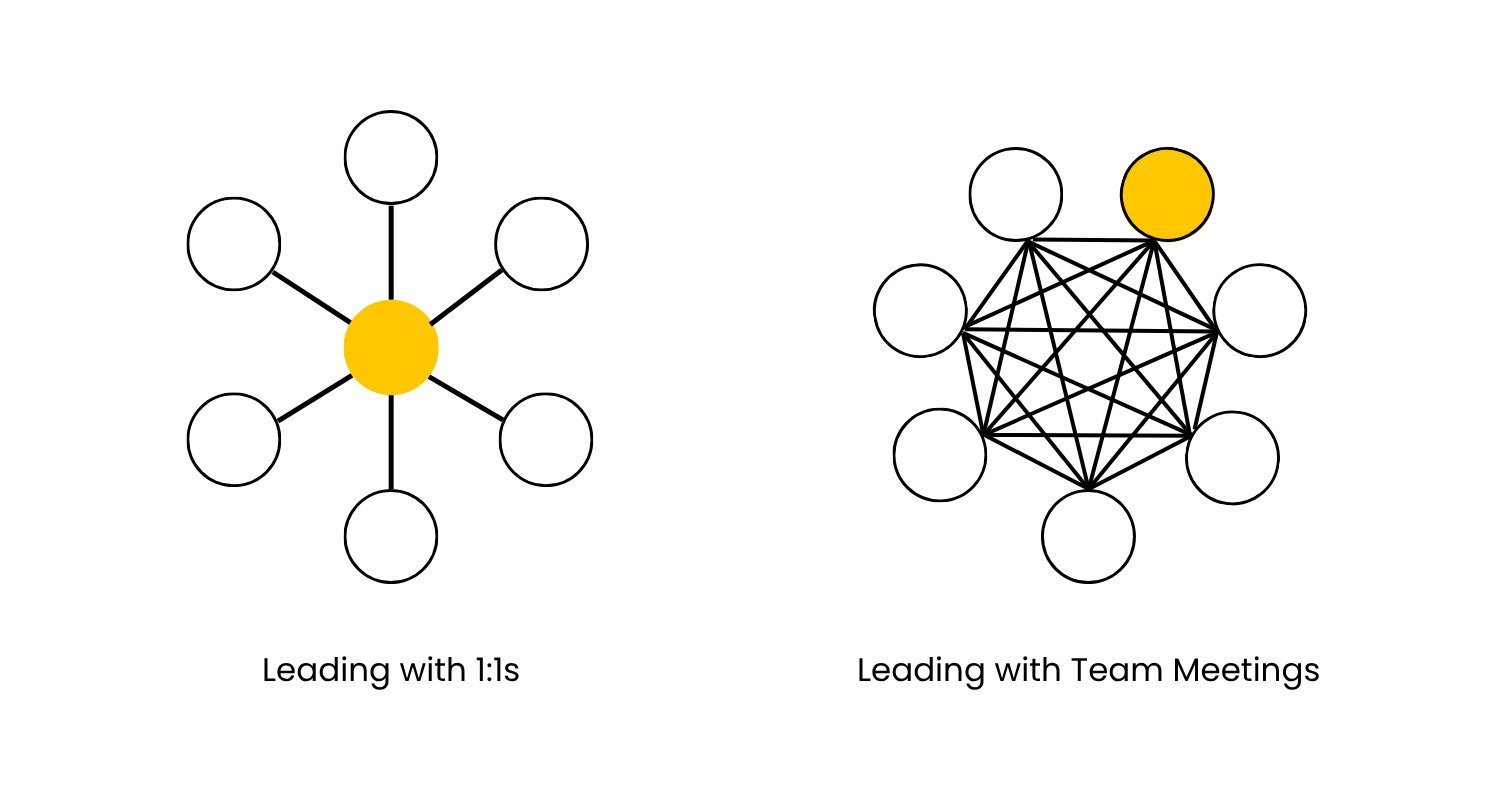
TLDR: Too many 1:1 meetings can create bottlenecks and dependency, making leaders indispensable instead of empowering their teams. Reduce your 1:1s to fewer, higher-quality career conversations, and shift your time to team-driven meetings like Momentum Meetings, Tiger Teams, Cross-Functional Capability meetings, and Joint Assignments.
Too many 1:1s
A CEO client complained recently that her team works in silos. “They never coordinate with each other, it falls to me to make sure they’re synced up, and it’s driving me crazy!”. She felt particularly challenged because her business is consumer-facing and relies heavily on multiple functions delivering a cohesive, smooth customer journey experience, and that was not happening.
Turns out she was spending 80% of her time in 1:1s and 20% in team meetings. My advice to her? Flip that ratio: 80% time in team meetings, 20% in 1:1s.
This is a bit of a controversial take. Many of my CEO clients love 1:1 meetings; they help them feel connected to their team members, plugged into what’s happening on the ground, involved in important decisions. But I often advise clients to consider shifting to more team-oriented meetings.
If you're spending most of your week in 1:1 meetings, you might be unintentionally creating dependency rather than fostering independence and collaboration within your team.
Ask yourself:
Are you constantly arbitrating conflicts instead of teaching people to handle issues directly?
Do decisions continually land on your desk, despite your team already having the necessary information?
Have you become the hub, or the only person holding the full picture?
Are you struggling to find enough time to do deep work or sleep?
If yes, it's probably time to rebalance your schedule to about 80% team-driven meetings and 20% high-quality, growth-oriented 1:1s.
Here's why too many 1:1s can create systemic drag:
Information bottleneck: Everything funnels through you, delaying decisions.
Conflict avoidance: Issues get escalated privately rather than openly resolved.
Dependency: Team members rely on you instead of building direct connections.
Political drama: People jockey for your support rather than collaborating transparently.
Here's a practical recommendation for how to reduce 1:1s
Maintain monthly or quarterly 1:1s dedicated to genuine growth and career development, run thoughtfully with empathy and listening.
Replace the rest with intentional, team-driven meetings designed to foster connection, collaborative problem-solving, and independent decision-making. Not too many; you want to be aware of meeting fatigue.
If someone says they really truly need a 1:1 to discuss something private, make the time for them.
(This is what a client, a CXO of a multi-billion dollar enterprise, does)
What to replace the 1:1s with: Four different types of team meetings
Here are four team meeting structures that serve different functions. Pick the structure that fits your needs:
1. Momentum Meetings
(For your team's weekly rhythm)
What they are:
A quick one-two series of E team meetings on Mondays and Tuesdays.
How to run them:
Monday: Surface issues standing in the way of your team’s “Three Must-Win Battles” (per Ruth Wageman, these are your critical strategic goals). Continue until each discussion concludes with clear next steps and owners.
Tuesday: Follow up on Monday’s action items. Team reports progress and unblocks what’s stalled.
When to use them:
When your startup has slowed.
When you want to increase momentum and alignment around priorities.
When you want that “startup feeling” back.
Why this works:
Focused Monday → immediate action Tuesday. (If Tuesday is too soon, a client of mine meets on Wednesdays)
Team unblocks itself in real time instead of waiting weeks.
Example:
One CEO client who’d been meeting monthly with their exec team made this switch—and team alignment and decision speed improved drastically.
Source: Bain & Company - "Founder’s Mentality"
Read more: “Reignite startup hunger with momentum meetings”
2. Cross-Functional Capability Meetings (2:1 or 3:1)
(For building your team’s unique capabilities)
What they are:
Regular meetings between 2–3 leaders tackling key team capabilities (e.g., customer satisfaction, innovation, speed to market, distribution).
How to run them:
Identify the team’s top 5 to 6 unique capabilities that create value.
Bring together the 2 to 3 leaders most crucial for building each capabiility.
Meet regularly to make decisions and execute.
When to use them:
When you need to move fast on each capability
When you want to free up time for the rest of your full team to work on bigger issues
When half the attendees in each regular team meeting don’t need to be there
Why they work:
Quick coordination. Less mediation. Freed up time for other team members.
Source: Ron Carucci (HBR) - “Why Senior Leaders Should Stop Having So Many One-on-Ones”
3. Tiger Team Meetings
(For mission-critical projects)
What they are:
Small, cross-functional groups (4–8 experts) tackling high-stakes projects.
How to run them:
Pick a mission-critical project (e.g., product launch, customer journey redesign).
Pull together decision-makers from key teams. Each should be crucial for the project’s success.
Meet weekly. Move fast. Unblock quickly.
When to use them:
New ideas aren’t getting off the ground fast enough.
Your org structure is too slow for what’s needed.
Why this works:
It’s like a mini-startup within your org. Everyone needed is in the room.
Example:
A client - SVP at a public company - used a Tiger Team to launch “in-store pickup” as purchasing moved online. Despite operational complexity, the team delivered in mere months.
Source: Originated from the military, made famous by NASA during the Apollo 13 mission, adapted widely across industries
4. Joint Assignments
(For interpersonal friction)
What they are:
When two leaders are locked in a persistent conflict, or just not collaborating well, assign them to jointly own and deliver a real, business-critical outcome.
How to run them:
Choose an issue that is causing conflict.
Tell the two leaders in conflict: “Come up with a promise that both of you can agree on.”
Crucially: don’t focus on the relationship directly. Focus on the outcome, and let alignment rebuild through joint ownership of a deliverable.
When to use them:
Repeated misunderstandings between senior leaders.
Political tension or territory guarding.
You’ve had the conversation already and nothing’s changed.
Why this works:
Per Peter Hawkins, teams and partnerships often repair when two things are true:
There's a shared purpose bigger than either individual.
There’s mutual accountability to deliver on it—together.
it’s more effective than another feedback conversation.
Example:
One CEO client paired their Head of Sales and Head of Product — two smart, driven leaders who consistently clashed because sales was closing deals but product was saying the promises couldn’t be delivered.
The CEO challenged them to come up with a joint initiative to build sales in a way that product could agree on.
They decided on “x% sales growth, with all sales conversations only selling features that are already launched. We will have a product person in the room who must be consulted before any client meeting and who will take feedback to the product features team”. They had to agree on the goal, co-design the solution, co-present it to the Board, and co-own the results.
Source: Peter Hawkins - "Leadership Team Coaching"
One thing to notice
In all of these team meeting structures, the leader does not have to be the main person to bring data or make decisions. The leader’s main job is to create the right conditions for the team to be excellent: Create the space and time to meet, make sure the right people are in the room, move the conversation along.
Try something small next week:
Which of these meetings resonates most? Start small. perhaps run a Cross-Functional Capability (2:1 or 3:1) meeting and see what shifts.
Let me know what you discover in the comments; I’d love to hear how it goes.
An important caveat about 1:1s
Don’t get me wrong, connection matters. As a facilitator for Stanford’s Interpersonal Dynamics course, I’m fully in favor of building strong, resilient connections between people. However, I think it’s important to built those connections between everyone on the team, not just between the leader and team members.
Good leaders listen deeply, empathize authentically, and create space for their people to bring forward what's important to them.
If you have fewer 1:1s, it's crucial that the ones you keep are exceptional. Let the team member set the agenda and run the meeting to ensure their needs are genuinely met.
Resources and References:
Ruth Wageman & Richard Hackman - "Senior Leadership Teams: What it Takes to Make Them Great"
Peter Hawkins - "Leadership Team Coaching"
Bain & Company - "Founder’s Mentality"
Ron Carucci (HBR) - “Why Senior Leaders Should Stop Having So Many One-on-Ones”
LucidChart - “Understanding the Tiger Team Approach”